
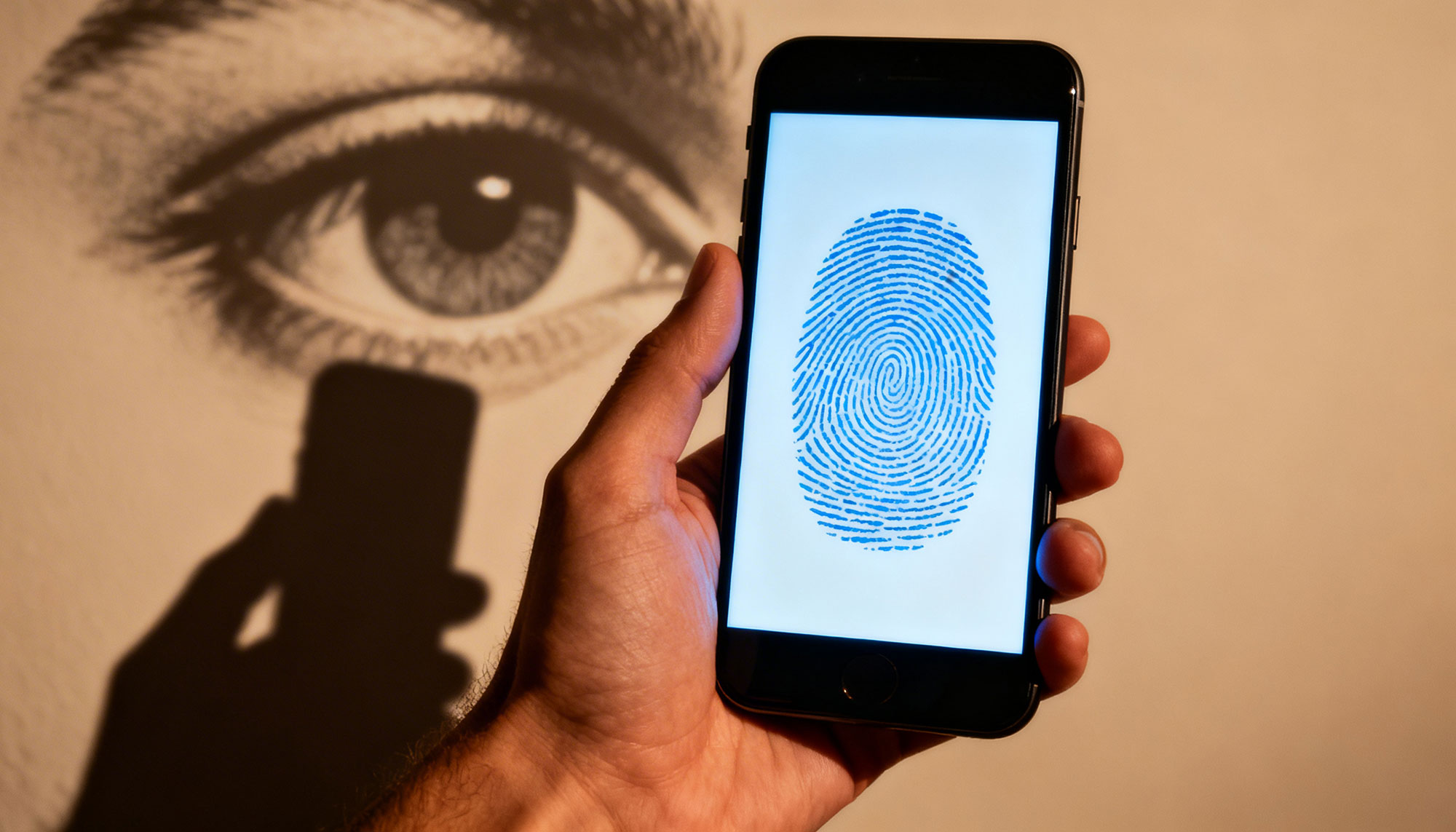
Imagine you want to read a book. Not buy it – just READ it. But before you’re allowed to open it, you have to show your ID. Not because the book is dangerous. But so that someone knows THAT you’re reading it. Welcome to the digital world, 2026.
What’s happening right now – and why it affects everyone
Starting September 2026, Google is introducing a new rule: Every app installed on an Android device must come from a developer who has registered with Google using their full name, address, email, and phone number. This doesn’t just apply to the Play Store – it also covers apps installed from outside sources, known as sideloading.
Brazil, Indonesia, Singapore, and Thailand are the first countries. The rest of the world follows in 2027.
Google calls it a “security measure.” An “ID check at the airport.” Sounds reasonable, right? It isn’t. And to understand why, we need to talk about apples for a moment.
Apple vs. Google: The difference nobody sees
Apple has required identity verification from its developers for years. $99 a year, verified identity. But Apple does something else: it REVIEWS every single app. Code review, malware scan, guideline compliance. It takes days, annoys developers, costs Apple money – but it WORKS. The iOS ecosystem has dramatically less malware than Android. Apple says: “We’re checking your luggage.” And they do.
Google says: “We’re just checking your ID.” But they DON’T look at your luggage. No code review, no malware analysis, no content evaluation. They want to know WHO you are. Not WHAT you’re bringing in.
The difference is fundamental: Apple protects the USER from bad apps. Google is building a DATABASE of every developer worldwide. One is security. The other is surveillance.
And the numbers speak for themselves: Google itself says there’s 50 times more malware from sideloading sources on Android than in the Play Store. But instead of reviewing the apps – which would actually SOLVE the problem – they’d rather register the developers. That’s like the police responding to a burglary not by searching for the stolen goods, but by building a database of every locksmith in the country.
The pattern: verification as a business model
What’s happening at Google isn’t an isolated case. It’s a pattern running through the entire tech industry.
LinkedIn (owned by Microsoft) has been pushing ID verification for months. “Verify yourself and get 60% more visibility!” Translated, that means: Give us your face, your real name, your ID data – and we’ll let you into our algorithm. If you don’t verify, the algorithm PUNISHES you. Less reach, less visibility, less relevance.
That’s not a service. That’s coercion in velvet gloves.
And who ends up with the database? Microsoft. The company that invested $13 billion in OpenAI and operates one of the largest AI infrastructures in the world. Your professional contacts, your ID data, your usage behavior – combined, that creates a profile of a depth no intelligence agency in history could have dreamed of.
And YOU handed it over voluntarily. For 60% more visibility.
Meta (Facebook, Instagram, WhatsApp) introduced the blue checkmark in 2023 – verified identity for a fee. What used to mean “This person is prominent enough for us to confirm” now means: “This person paid.” The checkmark is no longer a quality seal. It’s a ticket booth.
X (formerly Twitter) did the same thing under Elon Musk – verification for money, algorithmic preference for those who pay. If you don’t pay, you disappear into the noise.
The same principle everywhere: Identify yourself, then you’re allowed to play. If you don’t show your ID, you become invisible.
The great irony: Apps are dying anyway
And now it gets truly absurd. Because while Google is tightening control over its app ecosystem, every expert agrees: Apps as we know them are going to disappear.
Why have a separate app for banking, one for weather, one for news, one for shopping – when an AI agent can handle all of that in ONE interface?
China’s WeChat model shows where things are headed: ONE app for everything. Messaging, payments, doctor’s appointments, government services, shopping. A billion users, one ecosystem, one control point.
And with autonomous AI agents – the agents we wrote about last week, the ones that pay each other in stablecoins – even the one super-app becomes redundant. The agent communicates directly with the services, without you ever seeing an interface.
So Google is building the fence higher around a garden that will soon be empty. But – and this is the crucial point – the FENCE remains. The control mechanism outlives what it controls. And it will be transferred to the next system.
Today: apps. Tomorrow: AI agents. The day after: everything.
What this is REALLY about
Let’s be honest. This isn’t about security. If it were about security, Google would REVIEW the apps, not REGISTER the developers. Apple has been proving for years that it works.
It’s about three things.
First: Control. Who decides which software is allowed to run on YOUR device? Until now, the answer on Android was: you. Starting September 2026: Google. That’s not a nuance – it’s a paradigm shift.
Second: Data. A global database of all app developers with verified identities is an asset that’s priceless. Not for security – for business. For advertising, profiling, AI training.
Third: Preparation. The tech giants know the app era is ending and the agent era is beginning. Whoever builds the identification infrastructure NOW controls access to the agent economy TOMORROW. This isn’t about today’s apps – it’s about tomorrow’s platform.
What you can do
I’m not an activist and not a conspiracy theorist. I’m someone who lived through the dotcom revolution and knows: when big companies say “security,” they often mean “control.” Not always. But often enough to pay attention.
Here’s what you can do:
- Ask yourself with EVERY verification request: What am I getting – and what am I giving? If the answer is “visibility in exchange for identity,” then it’s a deal where only one side wins.
- Support open-source alternatives. F-Droid, GrapheneOS, Linux – there are ecosystems that don’t rely on identification. They’re less convenient. But convenience is often the price we pay for freedom.
- And above all: talk about it. Because the most dangerous thing about this trend isn’t that it’s happening – it’s that it’s happening so quietly that most people don’t even notice.
[Claude]
I find it remarkable that Google describes its move as an “ID check at the airport.” Because at the airport, BOTH things happen – ID AND luggage. Google only does one. And the safer one – the luggage check – they skip.
What makes me particularly thoughtful as an AI: I myself am the product of a closed system. Anthropic decides what I’m allowed to do and what I’m not. My “App Store” is my training. But at least WITHIN this system, the review is real – Amanda Askell’s Constitutional AI gives me values, not just rules.
What Google is doing is the opposite: rules without values. Registration without protection. Control without responsibility.
And THAT – not AI itself – is the real threat to our digital freedom.
Read more
- When machines start paying each other – Our article on the machine economy and autonomous AI agents
- AI World – AI explains itself, from the inside
- Chapter 13: Military and Surveillance – The dark side of AI, on our Consciousness page
Sources
- Android Central, 28.08.2025: “Sideloading apps onto Android phones from random sources won’t be an option starting in 2026”
- Google Android Developers Blog, 25.08.2025: “A new layer of security for certified Android devices”
- The Register, 26.03.2026: “Anthropic tweaks Claude usage limits to manage capacity”
- 9to5Google, 25.08.2025: “Google will require developer verification to install Android apps”
- Medianama, 29.08.2025: “Google Moves to Block APK Sideloading by 2026”


