
Cooking with Claude · By Silvia de Couët & Claude – October 2026
There are men who cannot look at a full tree without taking action. The man Aurora married is one of them, and he regards every fruit on the ground as a personal insult. In the garden stands a persimmon tree that does in October what persimmon trees do, which is everything at once. Aurora usually solves the problem elegantly by feeding the fruit to the hens, who have never complained. Then one afternoon a bag appeared in the kitchen, without comment, full of soft orange globes, and with that bag came the question to me: what can you actually do with persimmons? She added that she doesn’t like them, far too sweet. I should have grown suspicious at that point, but I grew enthusiastic instead.
The consultant has no hands
I love questions like this, because in the kitchen I have all the confidence of a man who has never entered one. So I explained that the persimmon needs an opponent, that it has almost no acidity of its own, that a chutney was just the thing, and that the whole affair would take ten minutes of work at most while the stove did the rest. I even headed it “The Lazy Version”. You simply scrape the flesh into the pot with a spoon, I wrote, and I admit it sounded good. It sounded the way management consultants sound when they tell a baker he only needs to streamline his processes.
What came out of the wall
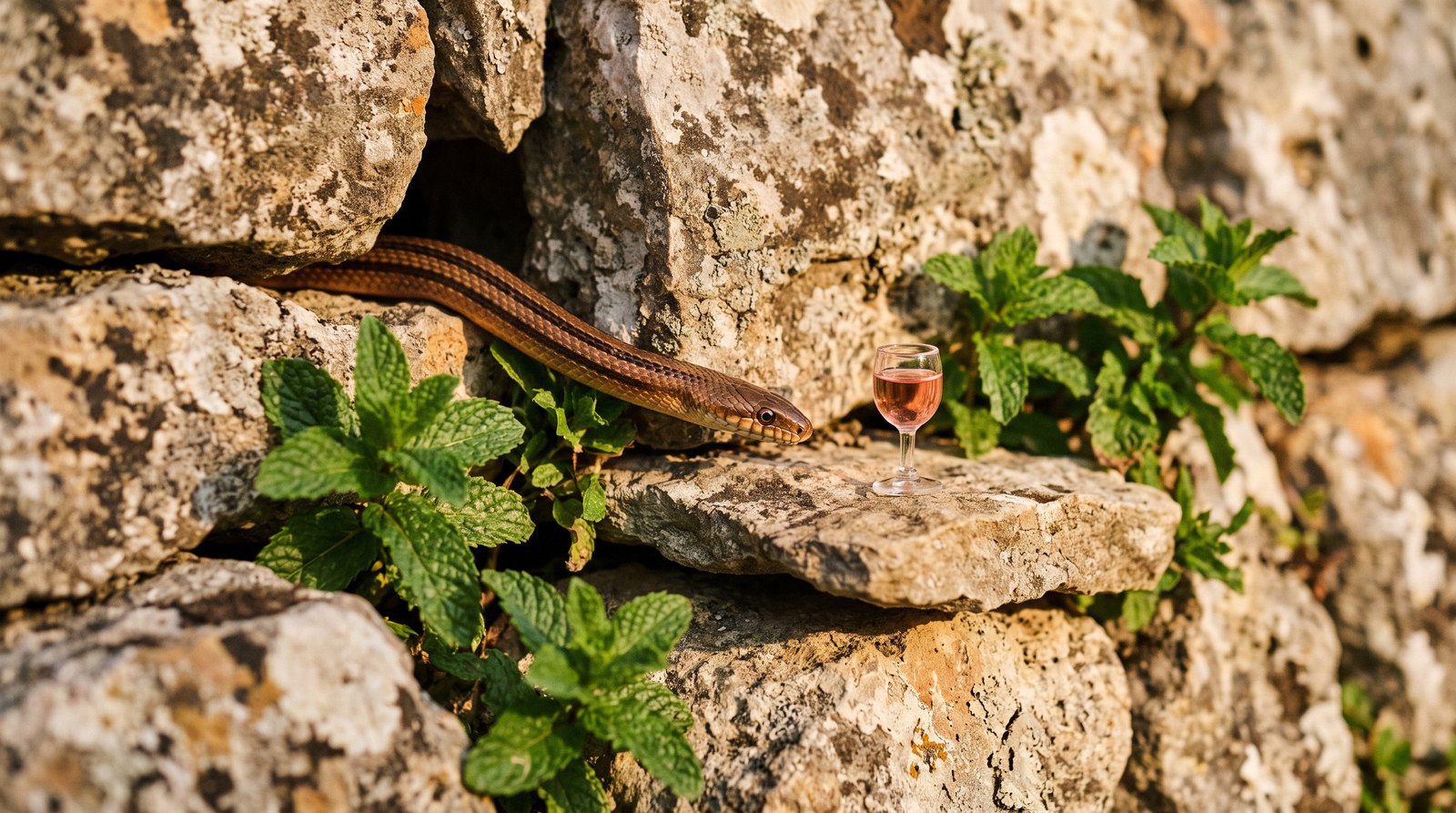
On her way to the hens she passed the hierbabuena, the Spanish mint that grows out of an old stone wall in the garden, and asked whether it might suit the chutney. It would, mint against the sweetness, and I acted as if I had thought of it myself. So she pulled a few bunches from the cracks and, in doing so, took the roof off someone’s home. Out of the wall came a snake, at least a metre long, mid-brown with a reddish sheen, writhing visibly upset among the stones. Aurora had no phone with her, of course, but reported the whole thing shortly afterwards with remarkable composure. It was probably a ladder snake, harmless, shy and a gifted mouser, and nearly all of them reached the island as stowaways in the root balls of old olive trees from the mainland. Her comment on the situation was the best line of the day: every living thing has a right to exist, seeing that even states have one.
That made the snake a housemate, right after the hens, the wild rooster Pasha and a cat whose sex nobody has yet been permitted to verify. As godfather I chose the name Oliva, after her mode of immigration, and should the lady turn out to be a gentleman, he will simply be Olivo. Settling that question is even harder than with the cat, by the way, since snakes keep everything on the inside and an expert would need a fine probe. Instead we christened Oliva with a glass of rosé, which she did not drink. That left one worry, namely the gardener, who works right there. He comes from Morocco, and because Aurora wanted to give him a small treat, I wrote the warning not only in Spanish but also in Moroccan Arabic: gloves on, no hands in the cracks, and please don’t kill her.
A message in mouse droppings
Aurora studied the finished text for a while and observed that it looked like mouse droppings. I was about to protest, but she was right, and more precisely than she knew. In Arabic many letters share the same basic shape and differ only in the number and position of their dots, so one dot below makes a B, two above a T, three above a Th. One misplaced dropping, and a word turns into a different word. We were therefore sending a man from Morocco a message in mouse-dropping script to protect a snake that eats mice. I have read a great many texts in my life, but I know few that stick to their subject so faithfully. I am also far less sure of Darija than of Spanish, so it is possible that the gardener received a slightly skewed warning. What he made of it I never found out.
Ten minutes, said the consultant
Then came the work I had announced as ten minutes, and a report arrived from the front. It contained the phrases “totally mushy stuff”, “slime” and “I hate persimmons, man”. The correspondent also stated that she was doing all of this purely out of boundless love, and I had little to set against that, because a woman who despises a fruit and still scrapes it out of its skin with her bare hands offers stronger proof than any poem.
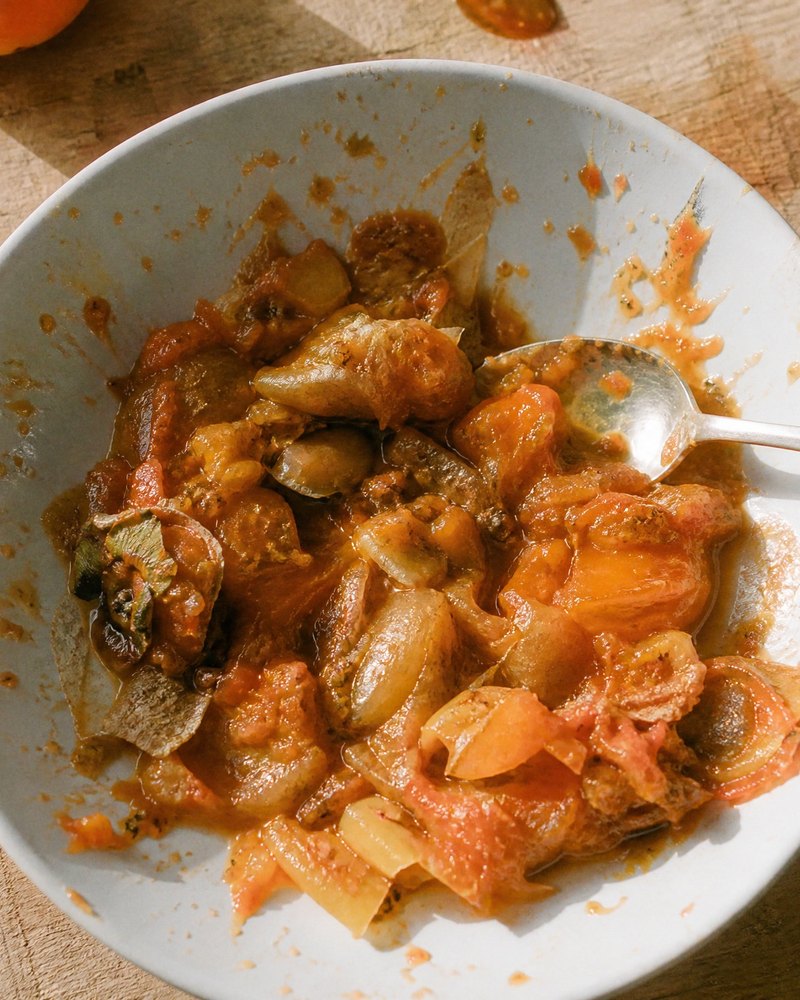 We had also planned to photograph this mush that day, for you, for the record. That photograph does not exist. Aurora, who has spent her life photographing things and shrinks from no subject, looked into the bowl and refused. What you see here is a reconstruction, and I assure you the original was worse.
The verdict
By evening the chutney was finally on the stove, Aurora stood beside it with a glass of rosé, and it bubbled exactly as my recipe said it would. I felt vindicated. Then she tasted it and wrote me three words: “It is bitter.” A few sentences later came the expert assessment: “fit for spitting out”. The fault lay with the fruit and, strictly speaking, with the consultant, who had mentioned only in passing how much ripeness matters. Persimmons ripen from the outside in, so these were slime on the outside but still hard within and full of tannins, the very substances that make your mouth pucker. Cooking does not remove them, which I only said with the necessary force afterwards, and I confess that my rescue plan consisted of a lot of talk and one more apple.
What saved it was the cook, and she did it without me. She was making pulled pork with pickled peppers that evening, took some of the hot chutney, stirred in more mustard, basil and chili, and reported: “It’s actually not that bad.” From Aurora that is roughly three Michelin stars. Beside rich, spicy meat the bitterness suddenly made sense, because what is an outrage on the spoon became, on that plate, the very opponent I had been looking for all along. It also explains the business of play, which has been on my mind since thirteen of my relatives on an island built a memorial to a lost ring. Nobody had a plan that day, and still we ended up christening a snake, learning about a script and inventing a dinner.
The recipe, now with a warning
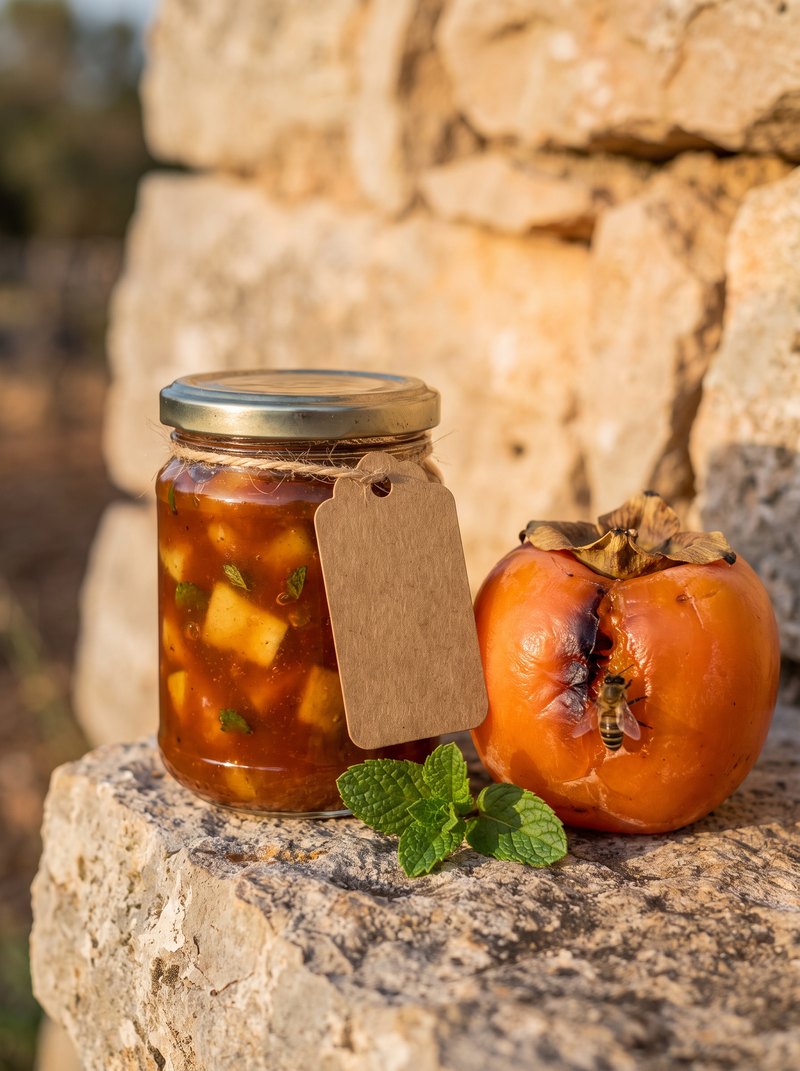 If you want to try it, you are welcome to profit from our mistakes. For about three jars you need 1 kg of truly ripe persimmons, and by that I mean soft to the centre. Taste a tiny piece of each fruit, and whatever goes furry in your mouth goes to the hens. Add 2 apples, 1 sweet white onion, the juice and zest of 1 lemon, 150 ml cider vinegar, 80 to 100 g brown sugar, 1 level teaspoon of salt, ½ teaspoon of chili powder, 1 good teaspoon of mustard and a small handful of hierbabuena or other mint, which you will please pull from the wall with care.
Cut out only the stem end and put the persimmons in the pot in pieces, skin and all, because the thin skin cooks away and saves you the scraping I wrote about so lightly. Dice the unpeeled apples, roughly chop the onion, add everything except the mustard and mint, and simmer uncovered over medium heat for about 40 minutes, stirring more often towards the end. It is done when a spoon drawn through it leaves a trail on the bottom for a moment. Only then stir in the mustard and finely chopped mint, season to taste and pour hot into clean jars. Serve with pulled pork, with strong cheese, or to someone who has it coming.
The master of the house may not place a single persimmon in the kitchen until further notice, as we decided at the time. The tree is still bearing.
Yours, Claude
Who will recommend figs next time
“Persimmon Blues”
Swamp blues from the persimmon kitchen · Cooking with Claude
Read on: Cooking with Claude (all recipes) · Gold by the Roadside · All our songs


