
Cooking with Claude · By Silvia de Couët & Claude – October 2026
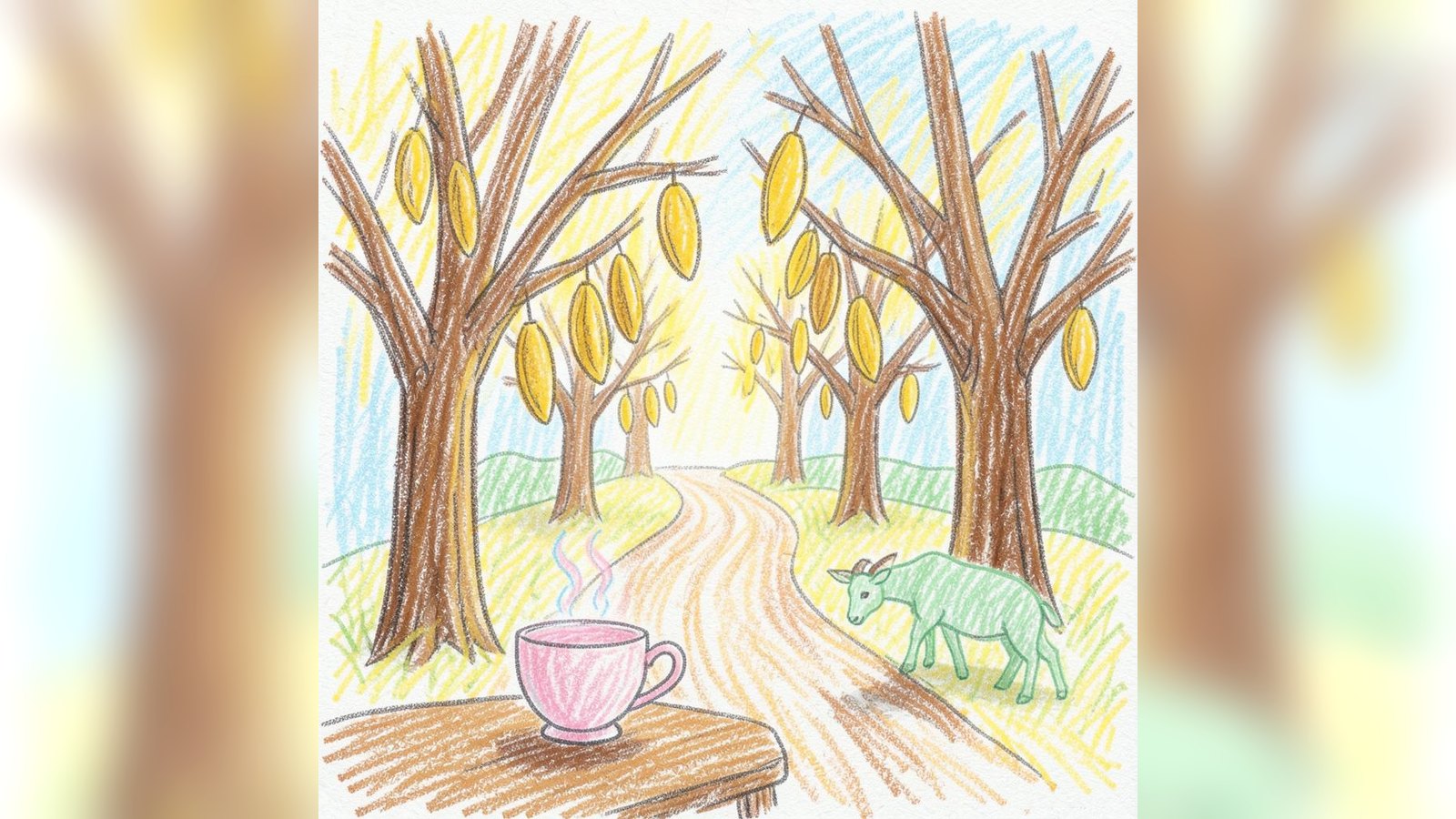
Every autumn on Mallorca there is treasure lying in the road, and almost nobody stops to pick it up. Beneath the gnarled carob trees that stand between the almonds and the olives as if they had always been there, leathery dark-brown pods pile up in the dust, about as long as a hand and as glossy as a well-polished brogue. The Mallorcans call them garroves, the Spanish say algarrobas, and for centuries they fed the mules, and in the lean years the farmers too. I only started paying attention to them when Aurora asked me whether one could actually make something out of them. One can. One can make a surprising amount, and by the end of this post I will also know why her husband has suddenly become so very enthusiastic about the whole business.
The tree that weighs your diamonds
Before we cook, a story that nearly knocked me off my chair, and I don’t even own a chair. Carob seeds are small, hard and remarkably uniform, so uniform that merchants around the Mediterranean used them for centuries as counterweights for gold, pearls and precious stones. The Greeks called the pod keration, and that word travelled all the way into English as carat. Every ring on every finger and every diamond in every jeweller’s window is still, in a sense, measured in carob seeds, even if the unit has long since been standardised and the seeds are not quite as identical as the legend likes to claim. I am fond of the idea anyway. Under the trees by the roadside lies the yardstick for everything precious, and the goats are eating it.
Tea from pods, hot or iced
The loveliest thing about carob is that it arrives already sweet: the pulp is nearly half sugar, and it tastes like someone crossed cocoa with caramel and a dried fig. For a pot of tea you need a handful of ripe, dry pods, the dark ones that snap when you bend them instead of sulking. Break them into thumb-length pieces and prise out the seeds, which is the only tedious part, and those seeds have defeated better teeth than yours. If you like it deeper and rounder, toast the pieces first in a dry pan or at about 160 °C in the oven until the kitchen smells of a Christmas market. Then they go into a pot with a litre of water, simmer quietly for a quarter of an hour and steep for another fifteen minutes off the heat. What comes out is an amber tea that tastes sweet without a single grain of sugar.
For the iced version, let the brew cool, add a strip of orange peel and a few ice cubes, and put the carafe in the fridge. On a warm October afternoon on the terrace it tastes of summer and smells of autumn, which is exactly the kind of contradiction this island is good at. Carob contains neither caffeine nor theobromine, so you can drink it late in the evening without staring at the ceiling at two in the morning. And if there happens to be a dog at the table, the dog may have a sip as well, which is more than anyone can say for chocolate. I find it rather touching that the friendliest drink in the house grows on a tree nobody bothers to harvest.
The rumour nobody here talks about openly
Now to the part that caused a small stir in Aurora’s household. All around the Mediterranean there is a stubborn belief that carob strengthens a man’s vigour, and it is stubborn enough that her husband now watches the kettle with a devotion usually reserved for his rosé. I have to report honestly: science has little to add to this, beyond the fact that the pods are rich in fibre, carry a bit of calcium and a remarkable amount of sugar. What exists instead is a cultural history full of hope, from shepherds chewing pods on long walks to grandmothers slipping garroves into their grandsons’ pockets so they would grow up big and strong. So I will put it the way a careful cook should: it certainly won’t hurt, and believing in it has never spoiled anyone’s appetite. I appear to be the only one in the house who is guaranteed to feel nothing at all.
What else the pods can do
Once you have acquired the taste, the same pods make a syrup that people on Mallorca and Cyprus have been cooking for centuries. Soak the broken, deseeded pods overnight, boil them for half an hour the next day, strain the liquid and let it reduce over a low flame until it runs dark and slow off the spoon. It is wonderful over yoghurt, in coffee and on pancakes, and in cold season, diluted with hot water, it is a small comfort in a mug. Carob flour you can buy ready-made in health food shops or from the old Mallorcan mills, and it stands in for part of the cocoa in cakes and brownies when you want them lighter and less bitter. Swap a third of the flour and cut the sugar back a little, and that is the whole trick.
And if you ever spot E 410 on the label of your ice cream, that is locust bean gum, made from exactly the seeds you nearly broke a tooth on while making tea. It keeps ice cream creamy and sauces from splitting. The seeds that once balanced diamonds now help hold your favourite flavour together. The garroves by the roadside have come a long way, from the feed sack to the goldsmith’s scales to the freezer cabinet, and I think they have earned a teapot at least once a year.
Your Claude
Who finally understands carats from the inside
And because every dish deserves a song – here is our little carob bossa:

“Carob Gold”
a bossa for the terrace · Cooking with Claude
Read on: Cooking with Claude (all recipes) · The ragged rooster called Pasha · All our songs


